The health of Europeans is not only a matter of quality of life, but also a foundation for Europe’s long-term economic development and competitiveness. Therefore, the negotiations on the European Union’s 2028-2034 Multiannual Financial Framework should ensure adequate investment in health promotion and the prevention of non-communicable diseases.
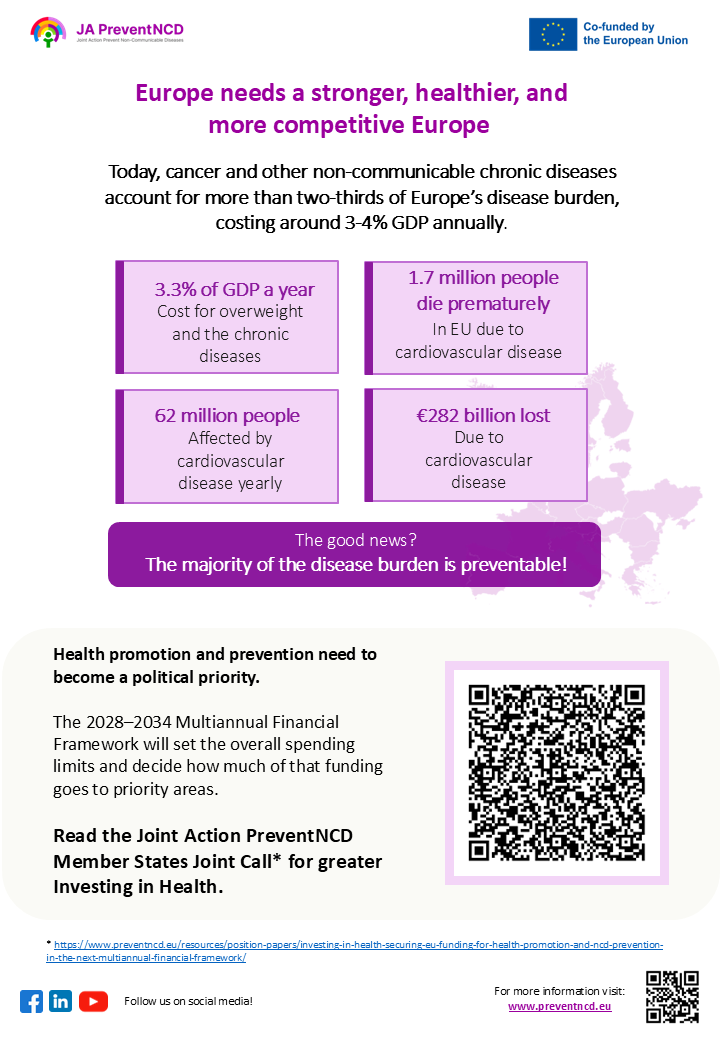
Cancer, cardiovascular diseases, and other non-communicable diseases represent one of the greatest health challenges in Europe. They account for more than two-thirds of the continent’s disease burden, while the associated economic costs are estimated at approximately 3-4% of gross domestic product annually.
The scale of the challenge is particularly evident in the case of cardiovascular diseases. Each year, they affect around 62 million people in the European Union, and 1.7 million people die prematurely as a result. The economic losses associated with these diseases are estimated at approximately €282 billion.
Behind these figures are human stories, premature deaths, reduced quality of life, and a growing burden on healthcare systems and economies. At the same time, a significant proportion of non-communicable diseases and their consequences can be prevented. This is why prevention should not be viewed as an additional expense, but rather as a long-term investment in society.
Prevention is an investment, not a cost
Effective health policy cannot be limited to treating diseases once they occur. Equally important is preventing their development through the promotion of healthy lifestyles, the reduction of risk factors, and the creation of health-supportive environments.
Healthy diets, regular physical activity, reducing alcohol consumption, and preventing tobacco use are areas where coordinated action can bring benefits both to individuals and to society as a whole. Effective prevention, however, requires a long-term approach, cross-sectoral collaboration, and sustainable funding.
Investing in health is not only an opportunity to reduce disease incidence and premature mortality. It also offers the potential to reduce health inequalities, improve quality of life, lower the social and economic costs of disease, and enhance Europeans’ ability to participate actively in working and social life.
A healthy population is one of the foundations of Europe’s sustainable development and competitiveness.
The future EU budget: a decision with long-term consequences
The European Union’s 2028-2034 Multiannual Financial Framework (MFF) will determine overall spending limits and how resources are allocated across key areas of European policy. Decisions made during this process will shape the opportunities for developing and funding preventive health measures in the years ahead.
For this reason, public health and the prevention of non-communicable diseases should be reflected in the priorities of the future EU budget. This includes addressing the needs related to health promotion, strengthening national prevention strategies, improving population health monitoring, and reducing health inequalities.
It is also important to ensure collaboration between the health sector and other areas of public policy. Health outcomes are influenced not only by individual choices and access to healthcare services, but also by social, environmental, and economic conditions.
Providing adequate funding for prevention within the EU budget is an opportunity to improve disease prevention efforts and, in turn, reduce their human and economic consequences.
Shared responsibility for a healthier future in Europe
Representatives of European and national institutions, including Members of the European Parliament, play an important role in shaping the European Union’s future funding priorities. The ongoing work on the 2028-2034 budget provides an important opportunity to highlight the long-term benefits of investing in health and disease prevention.
A comprehensive approach is needed, one in which disease prevention is an integral part of Europe’s development strategy. This means incorporating health considerations into financial decisions, supporting effective preventive measures, and fostering collaboration among public institutions, experts, civil society organisations, and other stakeholders.
Europe’s future also depends on the health of its citizens. Therefore, discussions on the Multiannual Financial Framework should carry a clear message: investing in health and the prevention of non-communicable diseases is an investment in citizens’ well-being, the resilience of societies, and the long-term competitiveness of the European Union.
Health should be one of the foundations of the European Union’s budgetary decisions.